

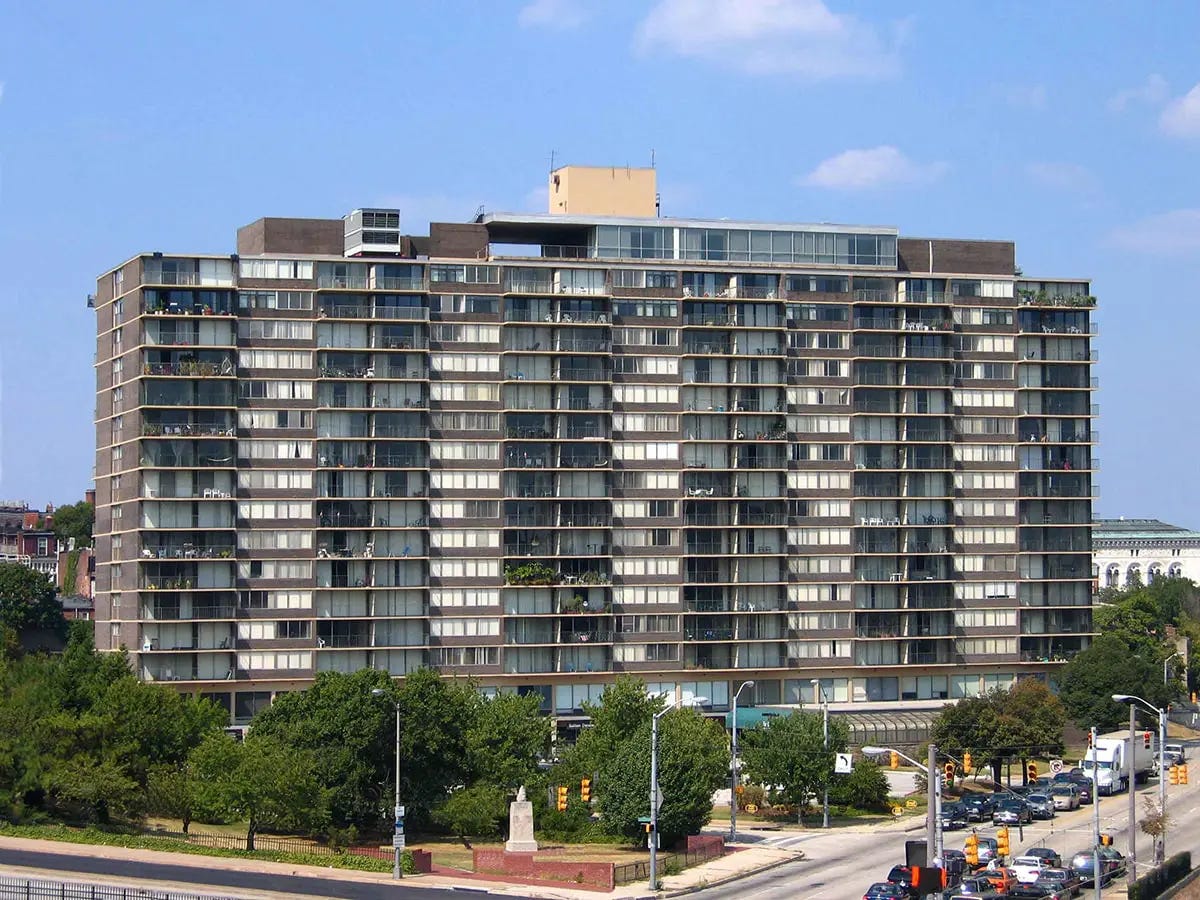
The recent renaming of Sutton Place to “ReNew Mt. Vernon” is curious for mostly geographical reasons. It is physically located in Bolton Hill, and even Mt. Royal, though not officially a neighborhood, seems more obviously associated with it than Mt. Vernon.
But this new, flashy name inadvertently functions as a call-back to the 16-story high-rise’s origins as the first luxury residential urban renewal project in Baltimore’s core.1 Sutton Place’s first decade in existence was a procession of farces.
We start in February 1961. Just over a decade has passed since the 1949 Housing Act ushered in the era of urban renewal, providing municipalities unprecedented condemnation power and funding. Developer Marvin Gilman, president of the Evans Realty Company, presented to the city Urban Renewal Commission (URC) his redesigned plans for the Sutton Place project, located on Lot No. 2 of the Mount Royal Plaza urban renewal area. The city had begun accepting proposals for a luxury apartment concept on the site in 1959, and Gilman’s Sutton Place proposal—whose name he chose because it suggested “distinction, snob appeal, and class”—won out. In response to concerns from Bolton Hill residents, the 300 units (distributed between two 14-story towers in the original proposal) would be contained in only one 16-story block, and the ground-floor commercial units would be “screened off” from Bolton Hill and face Howard Street. Gilman would have until August to secure a mortgage guarantee from the Federal Housing Administration.
He soon secured the guarantee. But what he was previously hoping for to make the project pencil suddenly turned into an impediment. By May 1962, Gilman came before the URC complaining that with residential mortgages guaranteed by the FHA, the project was too dependent on commercial leases and needed more. For the project to work out, he claimed, he needed to purchase and develop Lot No. 1, a cleared, 3-acre plot of land on the opposite side of Park Avenue. There he proposed more towers, this time both office and residential, that would complement Sutton Place. He stressed the importance that the two lots “be redeveloped harmoniously, both from an economic and an architectural point of view.” The URC turned down his request on June 13th, so Gilman tried to convince the Commission to get another developer in the mix as quickly as possible so they could coordinate.
Without any big plans for the adjacent parcel, Sutton Place nevertheless proceeded on schedule. On October 7, 1962, an article in The Sun detailed the towers’ amenities and declared it would open the following spring. The article also established Sutton Place’s historical distinction as “the first high-rise luxury apartment to be built near the central business district in 50 years.” The article revealed that 224 of 300 units would feature balconies, and that residents would enjoy covered parking, air-conditioning, a swimming pool, a penthouse roof with a restaurant, and, unusually, “piped music” received through the roof’s master antenna and listened through tubes on each television set.
The building was designed by Baltimore firm Jewell & Wolf, and had the distinctive feature “that the floors are of one thickness across, with no beams of greater thickness of the floor itself.” This is visible in the vertical, cream-colored concrete bands on the facade that lay bare the tower’s interior structure and emphasize the secure continuity between floor and cantilevered balconies. Mr. Wolf also noted “the obvious dramatic appeal of a rooftop restaurant overlooking the growing Baltimore skyline and harbor to the south and the green of Druid Hill Park to the north.”
During an AIA-sponsored lecture on “Architecture and Building” held at McCoy College2 in November 1962, Martin Gilman made comments that provide some texture to the pre-Civil Rights Act environment in which Sutton Place was being developed. Leasing for Sutton Place was taking place under a policy of “open occupancy,” meaning that there were no explicit racial restrictions. Gilman said that (paraphrased by a Sun journalist) “the inability of his rental agents to assure prospective tenants there would be no Negro families in the building has had some slight negative effect on leasing.” He argued that urban renewal in Baltimore was “doomed to failure” for as long as Baltimore’s Black population was barred from the suburbs—”but if you take the racial pressure off the center city, you will see a blossoming of urban renewal.”
Here, Gilman arrived at his position on county integration on a single-issue basis: as developer and owner of Sutton Place. According to Gilman’s logic and desires, if Black people were legally protected from housing discrimination in the county, they simply clear out of the city—which he deemed would protect his investment. Gilman’s rhetorical maneuver involved advocating for Black people’s rights in the county, but this moral purity was a pretense for advocating for “Negro removal” in the city. Even in the absence of an explicit call to “get them out,” Gilman’s words reveal a dangerous conceptualization of Black people as an ancient, perpetual, and pesky problem to be dealt with. Given the context, it is also possible that Gilman was referring to Baltimore City’s middle and high-income Black population (of the sort that might seek to rent at Sutton Place). In any case, Gilman’s vague and euphemistic use of the term “racial pressure” is an intriguing artifact from this story.
As Sutton Place neared completion in February 1963, Gilman urged city officials, community leaders, and engineers to visit the building and inspect the facilities. This was a defensive gesture by Gilman, who had been accused in a Sun article of dishonestly pocketing $357,000 earmarked for kitchen equipment and 10% builder’s profit (a “windfall”) provided by the FHA. Gilman assured the public that as owner and builder, he simply reinvested the $560,000 builder’s fee and the money previously meant for restaurant equipment back into the building. He argued that the money would have the ultimate effect of lowering rents, and that the Sun had dishonestly accused him of wrongdoing. The tour invitation was a reaction to these accusations, and he hoped to demonstrate the physical evidence of these extra investments. It appears the tour took place and satisfied the authorities.
On June 23, 1963, a large gaggle of dignitaries and civic leaders descended on Sutton Place for its official dedication ceremony. Consider what this must have looked like: at the time, Sutton Place was effectively a gleaming island surrounded by cleared urban renewal parcels and streets. This lends a special interest to the wordy remarks of Mayor Theodore McKeldin:
"In making the comparisons of yesteryear with the present, it is perhaps more important to provide a perspective on how this significant change in a historic Baltimore neighborhood can play a sympathetic role in the rejuvenation of the entire city. In that context, I think we must regard Sutton Place as inexorably intertwined with the historical forces of change now enveloping intown Baltimore.”
Central Baltimore, he said, “once a pulsating, throbbing giant of activity, slowly began to atrophy.” By 1963, some state government buildings had already filled in and around the Mount Royal Plaza urban renewal area, “but what was missing, was a plea for people, full-time people. People to return to the city to live. People to whom the city is a full-time experience. There is a certain efficiency and economy about a full-time city, after all. Even after 5 PM, water continues to flow in the pipes; electricity continues to pulse through the lines; the streets are cleaned and maintained, the city is protected—all on a full-time basis.”
McKeldin’s rhetoric pushes back against the post-war orthodoxy of workers commuting from the suburbs to their offices in the city—but his presentation of the “full-time city” as a daring and novel concept underscores how entrenched this spatial dichotomy was. The idea of the city as an “experience,” rather than an ancient, well-established form of settlement, was key in coaxing young people with money back to the city (and is still visible in promotional materials for luxury apartments). Finally, the “people” McKeldin references are not everyone, but a certain type of person—one who must be protected and supported on a full-time basis.
Gilman weighed in at the event too, noting “I felt that the Baltimore that I viewed in 1959 stood where Washington and Philadelphia had stood some seven or eight years before—on the threshold of vast redevelopment and revitalization activity.” Baltimore’s underdog narrative is nothing new, and can be an eye-roller—but there is some truth to idea that we lag behind DC and Philly by a few years in terms of development. Gilman’s observation that post-1949 urban renewal activity took longer to start up in Baltimore than in its Northeast Corridor neighbors would be an interesting topic to examine in more detail. If this is indeed true, why was more development teed up elsewhere—was it a question of the private sector, or of the sophistication of urban renewal authorities?
In April 1964, New York Governor Nelson Rockefeller, on the invitation of McKeldin, attracted a large crowd to the penthouse for a GOP primary event, during which he questioned whether the Apollo program was worth it. But after this high-status event, Sutton Place’s desirability began to decline consistently. By the end of 1963, only about 40% of Sutton Place’s apartments were rented. In response, the Zoning Board lowered the building’s original tax assessment of $2,944,800 by almost a million dollars. Gilman acknowledged the role of the surrounding “desolate land” in Sutton Place’s cool reception, and “predicted that occupancy would increase as the Madison-Park South urban renewal program [now known as State Center] progresses.” But by December 1965, occupancy remained low, at 65% (20% below the owners’ “break-even point”) and the FHA was forced to take over the mortgage. Gilman had moved from Baltimore to Wilmington, Delaware, and sold his ownership stake to another party.
Sidebar: parallel to all of this, fifteen townhouses, called “Bolton Place,” were under development in a little parcel directly west of Sutton Place. Developed by Van Arkel & Moss and designed by Baltimore firm Cochran Stephenson & Donkervoet, these contemporary townhouses were the first in Baltimore to be clustered around an interior courtyard—a conceptual precursor to later townhouse developments like Hugh Newell Jacobson’s Bolton Square and two of Louis Sauer’s projects: Penn’s Landing Square in Philadelphia and Harbor Walk in Baltimore. Additionally, between 1965 and ‘66, proposals were floated for a 101-unit walk-up condominium on Lot No. 1 called “Park Purchase,” also to be developed by Van Arkel & Moss. Plans, designed by Louis Sauer, were shown to authorities in September 1966, and the red-trimmed project seems to have been built at some point.
On August 9, 1966, Sutton Place went into foreclosure and the FHA acquired the building in an auction (the FHA being the only bidder). Following the FHA’s close inspections of the interior, it was revealed that serious deficiencies in construction quality had gone unnoticed by the URC when it approved the building in July 1963. A commercial tenant of the building’s ground-floor moved to Towson in January 1967, stating that “the general way the building is being kept is not conducive to running a professional business,” and citing “no measurable improvement” since the FHA’s takeover. Tenants were “in revolt”—Eugene Blum, who collected signatures and led effort to get improvements, was the victim of a year-long eviction attempt that the FHA eventually abandoned in September 1967. It took until 1972 for a group from Boston to buy Sutton Place, “long regarded locally as a white elephant.”
Sutton Place had the unfortunate distinction of being one of the most media-scrutinized buildings in the city, and a series of strange and unfortunate events added to the building’s legend. In 1966, a racket squad raided an apartment and charged a woman and three men with prostitution. In 1973, State Delegate James “Turk” Scott was gunned down in the Sutton Place parking garage while awaiting trial for transporting 40 pounds of heroin from New York to Baltimore. Two years later, a man died after falling from a 14th-floor balcony. In 1979, a long series of trash chute fires filled hallways with smoke and forced residents into the parking lot in bathrobes and pajamas.
It is my assumption that the fine property managers who have taken over “ReNew Mt. Vernon” are doing an excellent job, and that all past imperfections have been resolved (for now). But what better reason to closely examine the history—yes, history—of this now-nondescript building, and its significance in Baltimore’s evolution!
The Two Charles Center towers were built in 1968. Also, Sutton Place was only the second high-income/luxury apartment to be built near the city’s core since 1010 St. Paul was completed just after the end of WWII.
The former name for Johns Hopkins’ night class division.